
Over the years, we’ve worked with healthcare organizations navigating payer organization, workflow transformation, and enterprise technology initiatives. One pattern consistently emerges: regulations create urgency, but they rarely define the opportunity.
Mokxa Team | July 22, 2026
CMS-0057-F1 is one example of this shift.
With the 2027 deadline less than 6 months away, much of the market’s attention is focused on the mechanics like: FHIR2 APIs, prior authorization workflows, 72-hour / 7-day SLAs, public reporting, and implementation timelines across multiple payer relationships.
Necessary? Yes. But our conversations with delegated vendors and health plans reveal something bigger that many have yet to account for.

Regulatory Readiness Is Becoming the Baseline
We expect CMS-0057-F readiness to become table stakes. Once organizations have established the required capabilities, differentiation will shift toward operational excellence, automation, and measurable outcomes.
Tech Snippet
What unlocks FHIR's full potential?


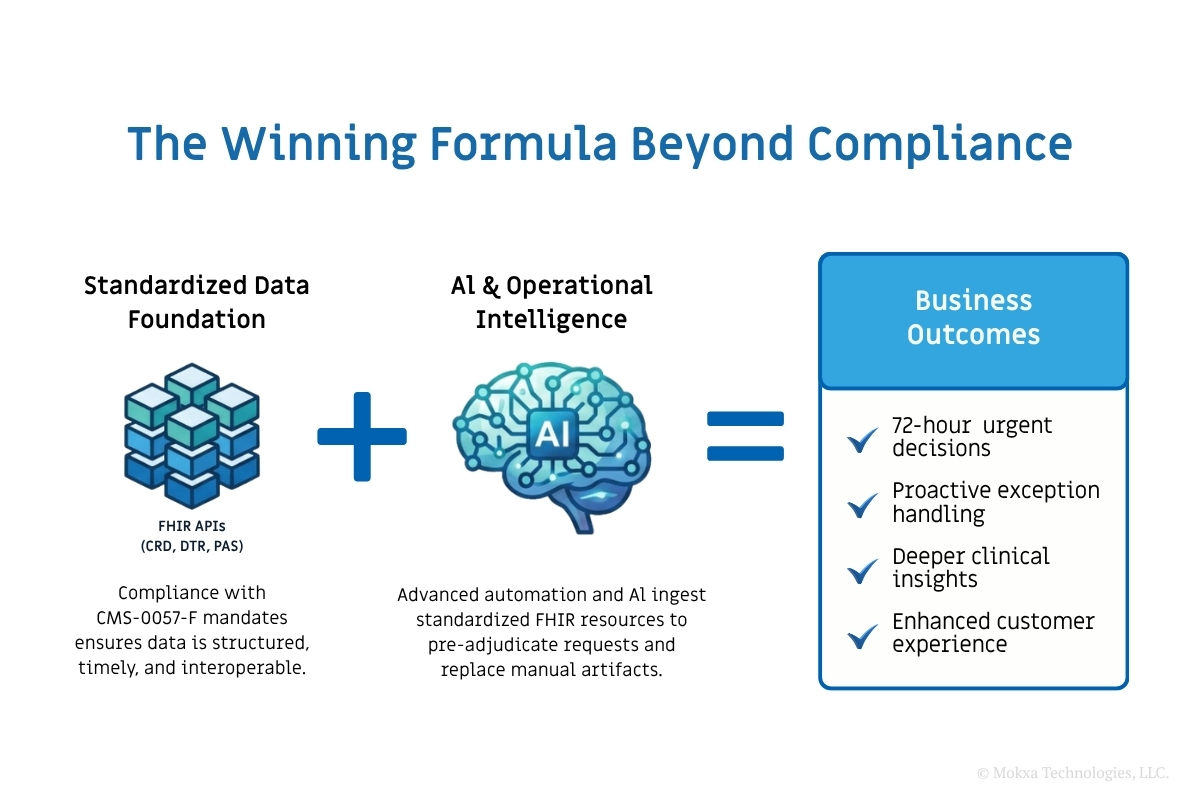
Interoperable FHIR data becomes significantly more valuable when paired with AI, enabling faster utilization management decisions, stronger clinical rationale, and better experiences for providers, members, and health plans.
After January 2027, health plans are most likely to ask a different question:
“Which delegated partner can help us reduce turnaround times, improve decision quality, and scale efficiently?”
That’s the new scoreboard as the industry moves toward AI-led operations and intelligent delegation.
Positioning for What Comes Next
Once the mandate takes effect, the organizations investing beyond regulatory requirements will be best positioned to retain their existing payer relationships while becoming the preferred partner for new business. Everyone else will be catching up.
Biz Snippet
How does FHIR reshape competition for delegated vendors?
 Health plans gain more freedom to evaluate and select the right delegated partner. Standardized interoperability lowers switching barriers, making operational performance the deciding factor (not technical capabilities!) Speed, transparency, consistency, and measurable outcomes become the real drivers.
At Mokxa, we’ve spent years working directly with delegated vendors to understand their operational realities, payer expectations, and their toughest open questions. Through that work, we’ve developed a practical understanding of the challenges delegated vendors face—from prior authorization workflows to interoperability, automation, AI readiness, and beyond.
Those experiences have shaped the frameworks and implementation playbooks that now form our executive toolkit—designed to help organizations navigate CMS-0057-F readiness with greater confidence.
Our goal is simple: help delegated vendors meet CMS-0057-F requirements while building enterprise capabilities they’ll need for the next generation of delegated care.
👉 Start chatting with Mokxa’s Delegated Vendor Alpha Agent now!
If you’d like to talk through your organization’s readiness or roadmap, our healthcare solutions team would welcome that conversation.
Expert Speak

Are your team preparing for CMS-0057-F?
Download Toolkit 
References:
SHARE THIS RESOURCE


Tech Snippet
What unlocks FHIR's full potential?
Interoperable FHIR data becomes significantly more valuable when paired with AI, enabling faster utilization management decisions, stronger clinical rationale, and better experiences for providers, members, and health plans.
“Which delegated partner can help us reduce turnaround times, improve decision quality, and scale efficiently?”
That’s the new scoreboard as the industry moves toward AI-led operations and intelligent delegation.
Positioning for What Comes Next
Once the mandate takes effect, the organizations investing beyond regulatory requirements will be best positioned to retain their existing payer relationships while becoming the preferred partner for new business. Everyone else will be catching up.
Biz Snippet
How does FHIR reshape competition for delegated vendors?
At Mokxa, we’ve spent years working directly with delegated vendors to understand their operational realities, payer expectations, and their toughest open questions. Through that work, we’ve developed a practical understanding of the challenges delegated vendors face—from prior authorization workflows to interoperability, automation, AI readiness, and beyond.
Those experiences have shaped the frameworks and implementation playbooks that now form our executive toolkit—designed to help organizations navigate CMS-0057-F readiness with greater confidence.
Our goal is simple: help delegated vendors meet CMS-0057-F requirements while building enterprise capabilities they’ll need for the next generation of delegated care.
👉 Start chatting with Mokxa’s Delegated Vendor Alpha Agent now!
If you’d like to talk through your organization’s readiness or roadmap, our healthcare solutions team would welcome that conversation.
Expert Speak
Are your team preparing for CMS-0057-F?
Download Toolkit
References:
SHARE THIS RESOURCE

